Why sleep is more important than most people think
Sleep is not passive rest. During the seven to nine hours the average adult spends asleep, the body runs a coordinated program of hormone regulation, tissue repair, memory consolidation, and immune maintenance. When any part of that program is interrupted night after night, the effects accumulate, and the mattress is one of the few variables under a sleeper's direct control.
Endocrinologists have documented that even a single week of restricted sleep measurably lowers testosterone, blunts insulin sensitivity, and elevates cortisol. Athletes lose recovery capacity. Office workers show declines in reaction time equivalent to legal intoxication. Immune response to routine vaccinations drops.
None of this is controversial. It is textbook physiology. What is less discussed is how much of this program depends on uninterrupted deep sleep, and how easily a poorly matched sleep surface can prevent it.
Is your mattress secretly ruining your sleep?
Most sleepers assume their mattress is doing its job unless it is visibly broken. In practice, four failure modes account for the majority of sleep complaints, and they rarely announce themselves.
Foams that trap body heat trigger micro-awakenings you do not consciously remember but which fragment deep sleep.
A partner shifting positions can pull you out of REM without ever fully waking you.
Poor contouring at the shoulder and hip restricts blood flow and forces frequent repositioning.
Low-density foams compress within 18 to 36 months, quietly misaligning the spine long before the surface looks worn.
Why most mattress companies cost more than they should
The retail price of a mattress is only loosely connected to what the mattress cost to manufacture. Most of the price tag pays for the distance between the factory and the sleeper, and every party in between takes a margin.
Saatva sells direct through its own website, skipping the big-box showroom and distributor markup that inflates the price of comparably built beds. Each additional link in the traditional chain adds roughly 20 to 40 percent to the price the sleeper eventually pays, without adding a single thread of comfort or a single millimeter of support to the mattress itself.
Meet Saatva

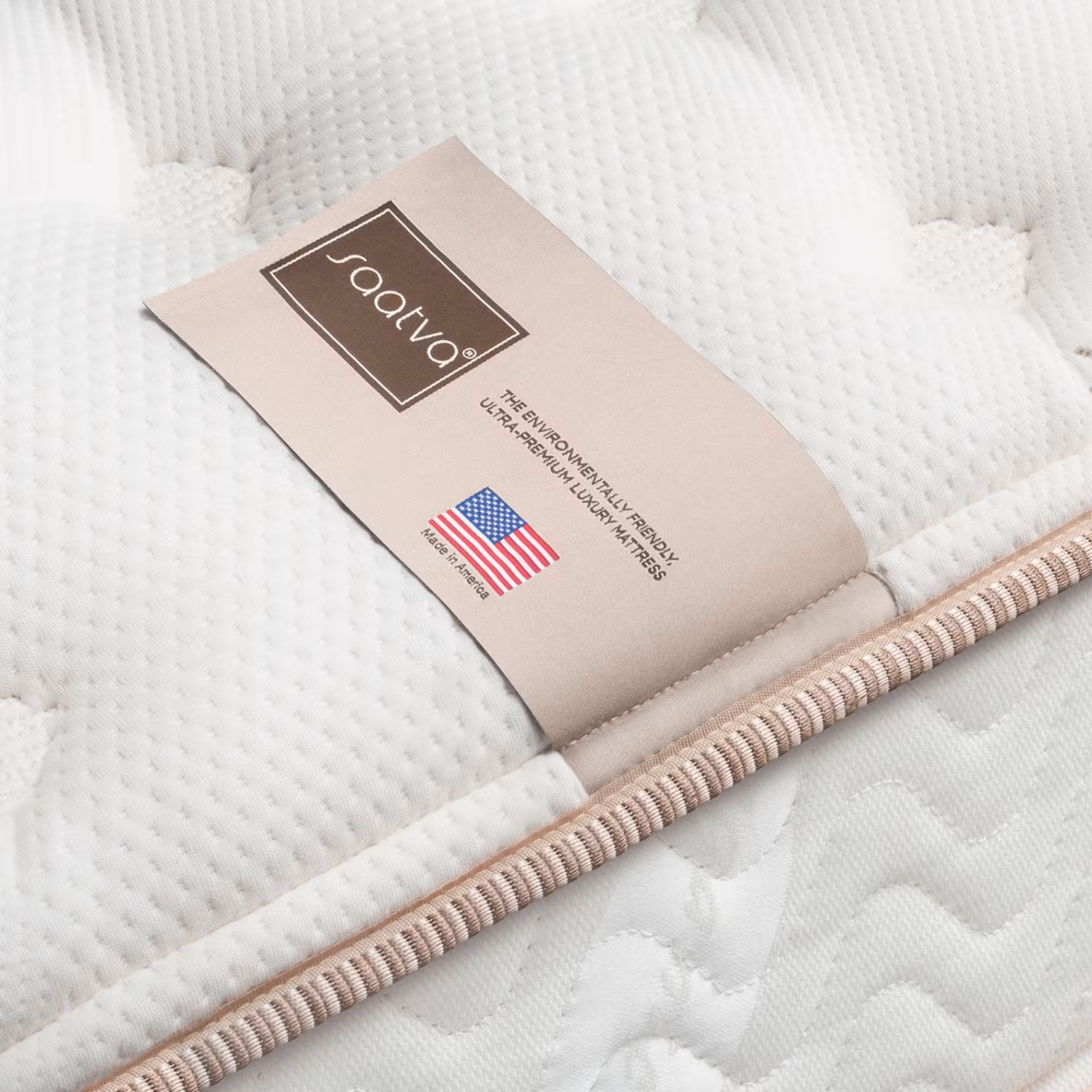
Saatva is a direct-to-consumer luxury sleep brand that sells exclusively through its own website. By skipping the big-box showroom and distributor markup, it offers handcrafted mattresses, built by specialty U.S. manufacturing partners, at a price closer to what the bed actually costs to make.
What makes Saatva different?
Built by hand, not a fully automated line.
Foams tested for durability and low emissions.
Set up in your room, old mattress removed, free.
A full year to test it, not the standard 30–100 nights.
Beyond the industry-standard 10-year coverage.
Innerspring, memory foam, latex, and adjustable builds.
Inside the mattress
A mattress is not one object. It is a stack of engineered layers, each with a specific job. Here is what each layer actually does for the sleeper, translated out of catalog language.
- 01Cover
The surface your skin touches. A well-made cover breathes so heat can escape instead of pooling around your body.
- 02Comfort layer
Gently cushions pressure around your shoulders and hips so you stop unconsciously repositioning through the night.
- 03Transition layer
Prevents you from sinking too far into the softer foam above by catching the deeper part of your body weight.
- 04Coils
The suspension of the mattress. Individually wrapped coils flex under one part of your body without disturbing the rest.
- 05Base
Anchors the whole system, keeps the coils aligned, and stops the mattress from sagging along its edges over years of use.
Saatva vs traditional mattress retailers
| Traditional retailers | Saatva | |
|---|---|---|
| Manufacturing | Mass-produced, generic | Handcrafted by specialty partners |
| Pricing | Includes distributor/retail markup | Direct-to-consumer, no markup |
| Delivery | Curbside, self-setup | White glove, old mattress removed |
| Home trial | Typically 30–100 nights | 365 nights |
| Warranty | Standard 10-year | Lifetime |
Frequently asked questions
365 nights, a full year to test it at home.
Should you buy Saatva?
- ✓Handcrafted quality
- ✓White glove delivery + removal included
- ✓365-night trial
- ✓Lifetime warranty
- –Not the lowest price point
- –Delivery takes longer than a same-week big-box order
- –More than needed for occasional/guest use
Saatva isn't chasing the lowest price. It's built for someone who wants to make one considered mattress decision, backed by a full year to test it and a warranty that outlasts the mattress itself.